
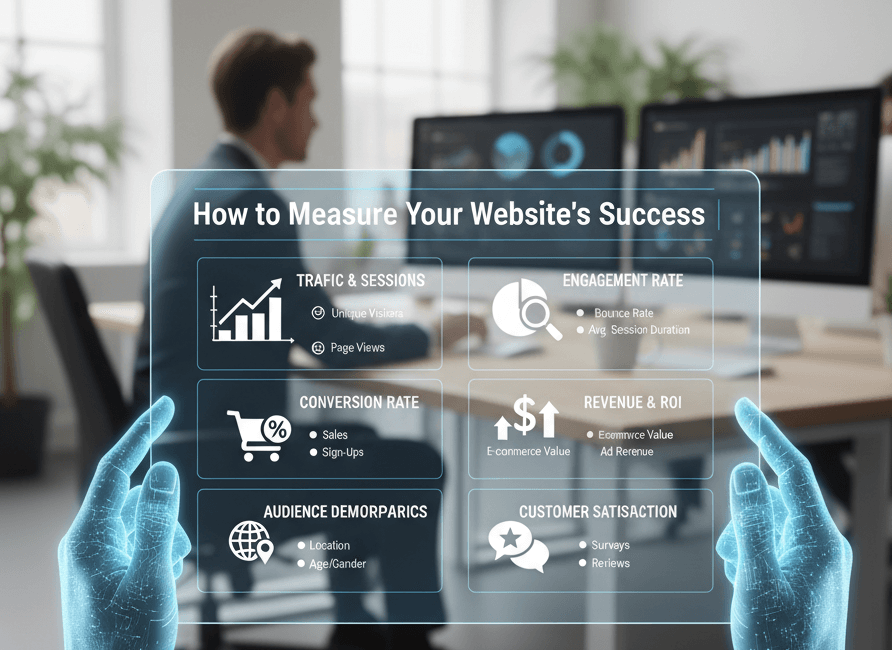
In 2025, having a website is no longer enough—what truly matters is how well it performs. Your website is the heart of your online presence, but how do you know if it’s actually helping your business grow? Measuring your website’s success goes beyond counting visits or likes—it’s about understanding how effectively it attracts, engages, and converts visitors into loyal customers.
Whether your goal is to increase sales, generate leads, or build brand awareness, tracking the right metrics gives you valuable insights into what’s working and what needs improvement. If you can measure it, you can improve it.
Here’s how to evaluate your website’s performance and ensure it’s achieving real results.
Define Your Goals Clearly
Before diving into analytics, you need to define what “success” means for your website. Every business has different objectives, and your metrics should align with them.
Ask yourself:
- Do I want to increase sales or e-commerce transactions?
- Am I aiming to generate more leads through forms or sign-ups?
- Is my focus on brand awareness and traffic growth?
- Do I want to improve customer engagement or retention?
Having clear, measurable goals helps you focus on the metrics that truly matter. For example, a content-focused business might track page views and time on site, while an e-commerce brand might care more about conversion rates and average order value.
Clarity is the first step toward measuring success effectively.
Monitor Website Traffic and Sources
One of the most basic yet powerful metrics is website traffic. It tells you how many people visit your site, where they come from, and how they interact with your content.
Key metrics to track include:
- Total visits: The overall number of users who access your website.
- Unique visitors: How many individual people visit your site (excluding repeat visits).
- Traffic sources: Where your visitors come from—organic search, social media, email, or paid ads.
- New vs. returning visitors: The balance between new leads and repeat customers.
By understanding where your traffic originates, you can identify which marketing channels are driving the best results and where to focus your efforts.
Knowing your audience’s journey helps you grow smarter, not just faster.
Measure Engagement Metrics
Getting visitors to your site is one thing; keeping them engaged is another. Engagement metrics reveal how well your website holds users’ attention and encourages them to interact.
Track metrics like:
- Average session duration: How long users stay on your site.
- Pages per session: How many pages they view before leaving.
- Bounce rate: The percentage of users who leave after viewing just one page.
A high bounce rate or short session duration often indicates that your content isn’t relevant, engaging, or easy to navigate. Improving design, loading speed, and content quality can help keep visitors exploring longer.
Engagement is a reflection of user satisfaction—and satisfied users convert.
Track Conversion Rates
Conversions are the most direct indicator of success. A conversion happens whenever a visitor completes a desired action, such as making a purchase, filling out a contact form, or signing up for a newsletter.
Key conversion metrics include:
- Overall conversion rate: The percentage of visitors who complete your goal.
- Form submissions: How many people contact you or request quotes.
- Sales and revenue: Total transactions made through your site.
- Click-through rates (CTR): How many people click on your calls-to-action (CTAs).
Tools like Google Analytics, HubSpot, or Hotjar allow you to set conversion goals and monitor performance over time.
Every click that leads to action measures how effectively your website turns interest into impact.
Analyze SEO Performance
A website can’t succeed if no one can find it. Search Engine Optimization (SEO) ensures your site ranks well on Google and other search engines.
Track your SEO performance with metrics such as:
- Organic traffic: The number of visitors coming from search engines.
- Keyword rankings: How your target keywords perform over time.
- Click-through rate (CTR): How often people click your link after seeing it in search results.
- Backlinks: The number and quality of other websites linking to yours.
Use tools like Google Search Console, Ahrefs, or SEMrush to monitor SEO health and identify opportunities for improvement.
SEO isn’t just about visibility—it’s about being found by the right people at the right time.
Evaluate Page Speed and Technical Performance
A slow or buggy website drives visitors away, no matter how good your content is. Since page speed directly affects both user experience and search rankings, it’s a crucial part of success measurement.
Use tools like Google PageSpeed Insights or GTmetrix to assess:
- Load time: How quickly your site appears on different devices.
- Core Web Vitals: Metrics like Largest Contentful Paint (LCP) and First Input Delay (FID).
- Mobile responsiveness: How well your site performs on smartphones and tablets.
Improving performance through optimization can lower bounce rates, boost conversions, and enhance SEO rankings.
Fast websites don’t just perform better—they build trust instantly.
Assess Content Performance
Your content is what keeps visitors engaged and coming back. Evaluate how well your blog posts, videos, or landing pages perform.
Measure:
- Most visited pages: Which topics attract the most attention.
- Average time on page: How long users stay on specific content.
- Social shares and comments: How often people engage with your posts.
- Exit rate: Where users leave your site.
Content that educates, entertains, or solves problems keeps users invested. If certain pages perform well, consider creating similar content. If others underperform, improve readability, visuals, or CTAs.
Great content isn’t what you post—it’s what your audience responds to.
Monitor User Behavior with Heatmaps and Recordings
Traditional analytics tell you what’s happening—heatmaps tell you why. Tools like Hotjar or Microsoft Clarity visualize where users click, scroll, or get stuck.
Heatmaps help you understand:
- Which areas of your site get the most attention.
- Where users drop off or ignore key elements.
- How visitors interact with forms or CTAs.
These insights let you refine layouts, adjust placements, and improve conversion pathways.
Understanding behavior turns data into action.
Measure Customer Feedback and Satisfaction
Numbers don’t tell the whole story—your visitors’ opinions matter too. Collecting feedback through surveys, reviews, or live chat helps you understand how people feel about their experience.
Ask questions like:
- “Was it easy to find what you needed?”
- “How satisfied are you with your experience?”
- “What can we improve?”
Positive feedback confirms what’s working, while constructive criticism reveals areas for growth.
Listening to your users is the best form of optimization.
Track Return on Investment (ROI)
Ultimately, your website should deliver measurable business value. ROI measures how much profit or value you get compared to what you invest in building and maintaining the site.
You can calculate ROI using this simple formula:
ROI = (Net Profit from Website ÷ Total Website Cost) × 100
Consider all costs (design, hosting, content, advertising) and all returns (sales, leads, customer lifetime value). A positive ROI means your website is generating more value than it costs.
ROI proves that your website isn’t just a presence—it’s a performance asset.
Conclusion: Track, Analyze, and Improve
Measuring your website’s success isn’t about collecting random numbers—it’s about turning data into direction. By tracking metrics like traffic, engagement, SEO, conversions, and ROI, you can see what’s working, fix what’s not, and make smarter decisions for growth.
In 2025, the most successful websites are not just designed beautifully—they’re managed intelligently.
When you measure, you understand. When you understand, you grow.
Your website’s success is a journey—and the data is your roadmap.